
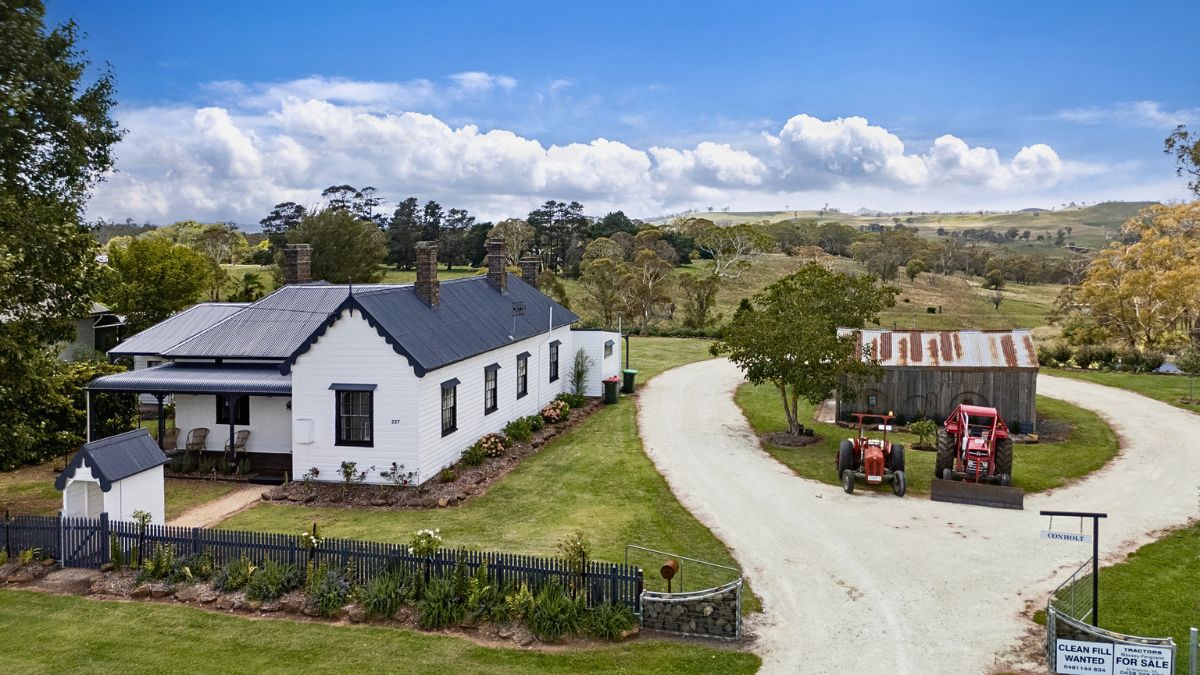
Nothing prepares you for a complete home renovation, particularly a dilapidated farmhouse where you cannot move through a single room and nothing appears to have been repaired since electricity was invented. Embarking on a country home renovation certainly brings its own unique set of challenges and surprises.
Before we could begin renovating Conholt, I became fascinated by the history of the property and the family who built it.
I promise not to bore you with a full history lesson, and if I’ve managed to get any of the facts wrong, please feel free to correct me as I am still learning about the property’s past myself.
What started out as a simple renovation project quickly became something much more meaningful. The more I learnt about Conholt and its connection to some of the region’s early pastoral families, the harder it became to think of it as just another old farmhouse.
Suddenly it wasn’t a case of “let’s fix her up and flip her”.
It became a labour of love.


The history made us feel a responsibility to preserve what we could and do the country home renovation properly.
As it turns out, Conholt wasn’t just an old farmhouse sitting quietly in the countryside. It was built during the height of one of the most successful pastoral enterprises in New England.
The story begins in 1838 when brothers George and John Everett arrived from England and headed north in search of opportunity. They established Ollera Station, a vast property northwest of Guyra, named after a local Indigenous word meaning “sweet water”. When their younger brother Edwin arrived a few years later, the three brothers officially formed a family partnership and together built Ollera into one of the region’s great stations.
By the 1850s, Ollera stretched across nearly 75,000 acres and carried thousands of sheep and cattle. It was so large and self-sufficient that it operated almost like its own village, complete with a store, school, church, bakery and even a cricket pitch.
Most people would have been content with one station of that size.
The Everetts were not most people.
In 1862, Edwin Everett expanded the family’s holdings even further by purchasing neighbouring Tenterden Station, adding another 48,000 acres to the family’s growing pastoral empire. While his brothers eventually returned to England to manage the sale of the family’s highly regarded wool on the London market, Edwin remained in New South Wales overseeing the properties and running day-to-day operations.
In 1864 he moved into the Tenterden homestead, where he would remain until his death in 1909.
This is where Conholt enters the story.
Built in 1890, Conholt was constructed during the golden years of the Everett family enterprise, when Ollera and Tenterden were operating side by side. Around the same time, the next generation of the family was arriving from England to take over management responsibilities, ensuring the Everett legacy continued.
Even the name Conholt has English roots. Conholt Park was an estate in England connected to the Everett family’s world, and it is believed the farmhouse took its name from there, bringing a small piece of home to the New England Tablelands.


Standing on the property today, it’s hard to imagine the scale of what once existed here. What is now a quiet farmhouse was once part of an operation that helped shape the region and contributed to the growth of the New England grazing industry.
When we first walked through Conholt, we saw peeling paint, years of neglect and enough renovation projects to keep us occupied for a very long time. What we didn’t fully appreciate at the time was that we were also walking through a small piece of New England history.
It certainly made us feel a little better about the amount of work ahead of us.
And there was a lot of work ahead of us.
After 17 truckloads of furniture, bags of things we probably didn’t want to investigate too closely, and more than a few discoveries that had us questioning our life choices, the real work began.
What started as a renovation quickly became a restoration.
The more we uncovered, the more determined we became to preserve the character of the house rather than simply modernise it.
A huge part of that journey was Barry the builder.
Barry is one of those people who never seeks recognition and would probably be horrified to find himself featured in a blog post, but Conholt would not be what it is today without him. His attention to detail, ability to solve seemingly impossible problems and refusal to cut corners meant that every challenge was met with the same response:


“We’ll work it out.”
And somehow, he always did.
Windows were carefully repaired rather than replaced. Rotten timber was restored. Fireplaces were brought back to life. Floors were sanded and revived after years of wear.
One of my favourite parts of the project was seeing the original character of the house slowly reappear.
The decorative barge boards on the front of the house had deteriorated beyond repair, so rather than replacing them with something modern, the originals were painstakingly copied and recreated by Barry to match the historic design.
We also discovered that the two bedrooms on the left-hand side of the house had originally stood elsewhere on the property before being moved and attached to the main home many years ago.
Like so much of Conholt’s history, it seemed the house had already lived several different lives before we arrived. We were simply responsible for the next one.
One decision we never regretted was opening the house up to the beautiful outlook at the rear of the property. French doors were installed and the verandah rebuilt, creating a space where we could sit, enjoy the view and appreciate everything that had drawn us to the property in the first place.


Looking back now, it is easy to focus on the finished result.
At the time, however, it often felt like every completed job revealed two more waiting underneath.
The renovation took longer than expected, cost more than expected and tested our patience more than once.
But standing there today, knowing the history of the Everett family, the connection to Tenterden and Ollera, and the role Conholt played in that story, I am grateful we persevered.
We thought we were buying a renovation project.
What we actually bought was a small piece of New England history.
While Conholt may be finished, our renovation adventures are far from over. We are currently tackling the kitchen at Roseville, transforming one large space into two rooms that will hopefully work much better for country life. If you’d like to follow along with the next chapter, you can read about the start of the kitchen renovation here.


Leave a Reply