
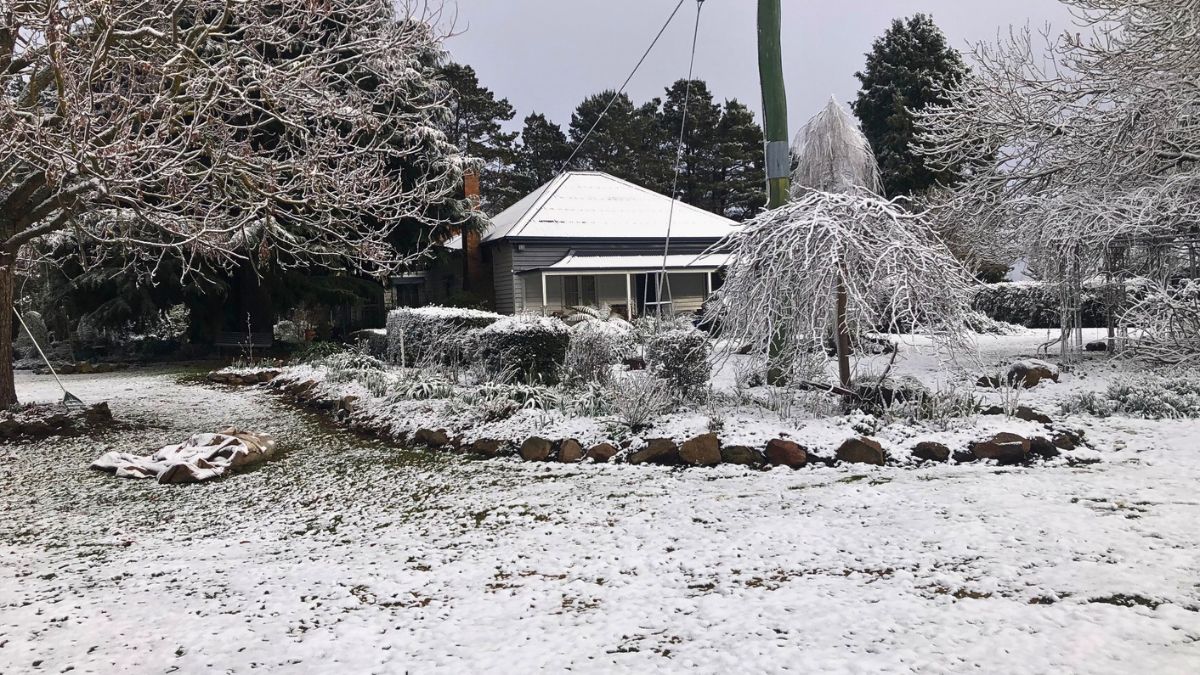
After a few busy weeks of kitchen renovations, Highland cows arriving, family visiting and a house full of activity, we are slowly starting to understand another important part of Roseville — the garden. Gardening in New England is unlike anywhere else, and it’s an exciting new adventure for us.
One thing that has become very clear since moving to the New England region is that gardening here is a completely different game to gardening in Sydney.
Having spent over 15 years running a garden maintenance business with Dad in Sydney, I wouldn’t consider myself a complete gardening novice. I can identify a weed, know my way around a pair of secateurs and have spent more hours than I can count pruning, mulching and doing a lot of walking around the garden and talking with clients.
Something that I do very well, I might add.

We are discovering that cold climate gardening is an entirely different skill set.
In Sydney, gardening is often about managing heat, keeping plants alive through dry spells and deciding whether something is getting too much sun.
In New England, people casually discuss frosts, bulb planting schedules and which plants can survive temperatures that make me question my life choices.
The more people I speak to, the more I realise that gardening in New England is deeply connected to the seasons. Understanding when to plant, when to prune and when to simply leave things alone seems just as important as knowing what to plant in the first place.
In fact, only recently I was convinced half the garden had died. I rang Dad to ask what we were doing wrong, only to be met with a very stern response:
“For God’s sake, do NOT cut the peonies back. That’s what they do over winter.”
Apparently not everything that looks dead is actually dead. Some plants are simply having a seasonal rest.

Much like me before my morning coffee.
Fortunately, I love learning new things and this garden is proving to be one very large classroom.
Learning to Work With the Seasons
One of the things I love most about the New England Tablelands is that you genuinely experience four distinct seasons.
The landscape changes dramatically throughout the year and so does the garden.
Autumn isn’t simply a period when leaves fall from trees. It is the beginning of preparing for winter.
Winter isn’t a dead season. According to every gardener I have spoken to, it is a season of planning, pruning and patiently waiting and it does have some beautiful colours of its own.
Spring is when everything bursts back to life.
And summer is when all your hard work either pays off or gets eaten by something.
Hopefully not Toast, although Hamish and Fergus currently seem far more interested in eating grass than assisting with garden destruction.

Frost Is Apparently a Big Deal
Coming from Sydney, frost was something I occasionally saw on social media.
In Guyra, frost is a regular topic of conversation. In fact this year we have had less frost than last year despite many days on the weather map saying “3 degrees but feels like -3 degrees”.
People discuss frost the way coastal communities discuss the surf. Like the other night at the pub, barman Steve told us that if the wind dies off, tomorrow will be a frosty one.
I have quickly learned that planting the wrong thing at the wrong time can end in disappointment. Dad has reminded me not to get too excited about the veggie garden preparation until after the frosts.
Noted, thanks Dad.
Fortunately, I seem to be surrounded by people who have decades of experience and are more than happy to share advice.
It turns out the plants know exactly what they are doing.
I am the one trying to catch up.
The Garden at Roseville
One of the things that attracted us to Roseville was the garden.
Even though we are still getting to know it, you can already see the incredible bones that have been created over many years.
Thank you again Dad.
Thankfully, even though Dad has moved into town, he still appears regularly to make sure we haven’t completely destroyed fifteen years of his hard work.
There are established trees, beautiful garden beds and signs of careful planning and dedication everywhere you look.

Every week we seem to discover something new.
The challenge now is learning what is already there before I enthusiastically start changing everything.
Although, if you have been following along, you will know my patience with this approach lasted approximately five minutes.
Bulbs, Blossoms and Big Plans
One thing that everybody keeps telling me is to wait until spring.
Apparently spring in the New England region is spectacular.
Bulbs emerge, flowering trees burst into colour and gardens wake up after winter.
I have heard this so many times now that I am beginning to think spring may be treated as a major public event.
I am certainly looking forward to seeing Roseville come to life.
The front garden project is already underway and, as you know from one of my last post, we have dug out the old garden beds, the seventy-year-old ferns have found their new home and we have already planted the buxus and roses.
I have now also discovered Erica Darleyensis, a beautiful little pink flower that blooms through winter and early spring. It should create some wonderful colour at the front between the buxus and roses while still staying low enough not to hide the house. I have also found a new weeping cherry, a weeping apricot and discovered we only need two more crab apple trees to complete an existing row. Slowly but surely, the pieces of the puzzle are coming together.
Apparently I can wait patiently for some things.
Thankfully for everyone involved, some things can actually be planted now.
Just not all the garden projects currently living in my head.

Learning From the Experts
One unexpected benefit of moving here has been discovering how generous gardeners are with their knowledge.
The Guyra Garden Club has already introduced me to people with years of experience growing everything from roses to vegetables.
I suspect that over the next few years I will learn more than I ever expected to know about soil, frost, pruning and plant varieties.
I will also almost certainly make mistakes.
Probably quite a few of them.
Fortunately, gardening seems to be one of those hobbies where mistakes are simply part of the process.
At least that’s what I keep telling myself.
Looking Ahead
For now, we are spending our time observing, learning and trying not to get too carried away.
Although, judging by recent events, our definition of “not getting carried away” may need some adjusting.
The vegetable garden is still in the planning stage because, for once, we have decided we may already have enough going on.
We have the Guyra Garden Club annual lunch coming up with a wonderful guest speaker who has also offered to come and visit the garden, which we are very excited about.
More on that adventure later.
I might perhaps be slightly nervous that we have confidently put our hand up for the New England Garden Festival, as I mentioned before. I am now fully understanding what we have committed ourselves to.
Although, based on recent events, this does appear to be becoming a bit of a pattern.
And somewhere in between all of that, we are slowly learning how to garden in a region that truly experiences all four seasons.
The plants seem to know what they are doing.
Hamish and Fergus seem to know what they are doing.
We are the ones still catching up.
But that is all part of the adventure.